
As it appears on the Dorset Planning Portal, dated 24 November 2026
I strongly object to the desecration of the Grade II * registered Park and Millground Meadow in order to fund what is essentially a private business. The applicant is using the so-called “ restoration of a heritage asset” as a smoke screen for what is actually a commercial venture. First of all it is not a restoration but repairs. Historic England as well as SPAB consistently use the term repairs in their documents. The planning authority must be satisfied that any departure from normal planning policy is both necessary and justified by clear and compelling evidence not assumptions.
1. The applicant must demonstrate that the proposal represents the minimum intervention necessary to secure the heritage asset. In my view, the information presently available does not adequately demonstrate this, even with his latest tinkering and small reduction of quantum. It is unclear whether the number of houses, even reduced of late, is the minimum necessary to address the conservation deficit. Why 71 houses, why not 50 fewer? This application should be supported by robust and independently scrutinised evidence regarding repair costs, projected revenues, conservation deficit, development values and alternative funding options.
Despite the vast number of documents one has to plough through, I have failed to see evidence, but I have seen plenty of what I would call “assumptions” in the documents presented by the applicant.
2. Insufficient weight appears to have been given to the harm arising from development within the historic estate setting. Parnham does not just derive significance from the building but from its historic relationship with the surrounding landscape, parkland, garden and associated views. Development that erodes this relationship risks causing lasting harm to the significance of the heritage asset.
Historic England actually said on 26 March 26 “The proposed development would seriously compromise the setting of Parnham House and in doing so would harm its significance. “The scale and damaging nature of these impacts would cause a high degree of harm to the significance of the park. This would be irreversible.” “ The historic park and gardens, and their relationship with the surrounding countryside would be greatly harmed by the proposed development”.
Dorset Council Officer on the 29 January 26 says “ I consider that the proposed enabling development would have a major adverse effect on the grade II * registered Park and Gardens, the site and the river Brit corridor as landscape receptors.”
The tinkering of this application has not changed any of the above impacts stated by Historic England and the DC Landscape Officer.
3. There is no evidence that reasonable alternatives have been thoroughly examined. We have just been told by the applicant, Savills and Tor & Co that there is no other way. The planning authority should be satisfied that less harmful options, including properly reduced development quantum, phased repair or other funding mechanisms, have been properly assessed before concluding that the current proposal is justified. The submitted material does not demonstrate a rigorous assessment of less harmful options.
4. The public benefits claimed for the scheme should be carefully scrutinised. The authority must be satisfied that the benefits clearly outweigh any identified harm and that the scheme represents the less harmful means of securing those benefits.
On numerous occasions, we have been told by the applicant and his team that there is going to be so much economic benefit resulting from this and I would challenge their assumptions. First of all, the claims are modelled, relying on projections and assumptions not evidence. The “hundred jobs” cited are misleading as they are mainly construction which will be temporary and might well be given to people from outside the area ( building contractors from further afield). The jobs on the estate are already in place, gardeners, estate managers and so on. According to Tor & Co page 38 of the latest document there are already 15 to 20 staff in place. The only creation will be some waiting staff, a few cleaners which are usually part-time and badly paid .
On page 39 of the said document, Tor & Co also cites various benefits like supporting infrastructure, upgrading the existing vehicular access, construction of surface water drainage ponds, installation of utility infrastructure, tree landscaping, an amended public right of way route. All the above are usual requirements so it can hardly be considered as a benefit.
I feel the economic impacts are inflated and overstated. The benefit will be short-term, due to the construction spending. Medium term it will be minimal. Long term it will pale into insignificance especially if they have destroyed the very thing ( idyllic landscape) that attracts tourists to our little town.
Aspinall Verdi says in their report “ We note there is no reference to the impact of the proposed ED on the attractiveness of the hospitality opportunity…” The question is, once the Heritage Landscape is gone, why would anyone come on holiday to Beaminster? In short, the economic uplift is marginal, speculative and insufficient to outweigh the harm to the landscape, heritage and the infrastructure.
5. There are several aspects of finance that are of great concern. The applicant has been granted several planning permissions for different forms of accommodation. None of them have been properly started and delivered. It is therefore a legitimate question to ask why? Is the applicant relying on money made by the Enabling Development to carry out the building of these permissions? In fact, Aspinall Verdi said on 6 July 26 that ”The planning consents for much of the ancillary development have been secure for some time and could have been progressed. This could have helped to both smooth capital outlay, establish the venture and indeed generate income.”
How is Dorset Council going to be certain that all the money raised by the development is going to be used for the sole repair of Parnham House and its upkeep and not the building of the ancillary developments, which would be contrary to policy on Enabling development as it would be for private business enterprise?
At the moment there is insufficient evidence of an enforceable mechanism ensuring the repair work is completed. Without such safeguards, the Council would be exposing itself to the risk of heritage harm without conservation benefits achieved.
Historic England has shown some concern about the complexity of ownership and has stated that “ if the financial case supporting the proposals is not substantiated then the proposals should be refused”.
A robust S 106 agreement should contain certain essential safeguards:
Detailed schedule of repair works
Timetable for delivery with cost verification
Dedicated escrow account managed by someone appointed by the council
Occupation triggers linked to repair milestones
Independent certification of completed work
Independent auditing
Annual monitoring reports
Sales receipts
Build cost information and professional fee information
Long-term management obligations
Periodic viability reviews
Claw back mechanism if development values exceed assumptions.
Overdevelopment protection
Default provisions
The wording of the S106 is crucial as it will indicate if the “ promised restoration” is genuinely guaranteed or merely intended. Promises made during the application process have absolutely no value whatsoever unless secured through legally enforceable obligations. Without such a mechanism, the council could face the criticism that it allowed harmful development in the countryside but had no legally enforceable way of ensuring the heritage gains materialise.
Is Dorset Council satisfied that a S106 could genuinely guarantee delivery of the heritage benefit? Would the Council be prepared to enforce the agreement, given its limited financial and manpower resources? Would it be prepared to take court action if the developer fails? Those are all questions that Dorset Council should consider.
The applicant seems to be heavily dependent upon assumptions regarding future market performance. Should these assumptions prove inaccurate, there is a substantial risk that the enabling development would proceed while the promised heritage benefits are reduced, delayed or only very partially delivered.
Tor & Co, in page 23 para 3.14, states,” as particularly relevant to the proposal, policy HO7
Meeting the need for homes “ substantial weight should be given to the benefits of providing homes which will contribute to meeting the evidenced needs of the area of the local planning authority.” I certainly would be interested to know how many locals are going to buy the proposed houses? It is interesting to note that the DC Housing Team said in Dec 2025 that it fails to address the significant local and Dorset-wide need for affordable homes. How will these homes meet the evidenced need of the area”?
These houses are not needed no matter how Tor & Co tries to dress it up. What is needed in Dorset, like much of the country, is affordable homes. The housing market is at an all time low, falling from 80 000 properties sold on October 25 in England & Wales to a mere 10 000 in October 26. This does not seem to have been taken into account by the applicant. The market fluctuates and as we are in a particularly difficult period is likely to stagnate for some time to come.
6. It is also worthy of notice that in his latest document from EPR Environment Statement Appendix D Ecological Impact Statement, on at least 5 occasions it states “ woodland is in unfavourable and declining condition due to lack of conservation management.” This is also stated about grassland. According to Historic England, the owner is responsible for the upkeep of the heritage asset. I have lived in Beaminster for 39 years and have seen the parkland and Millground Meadow deteriorate so rapidly during the last 5 years. It is in a shocking state and shows a complete lack of care for the heritage asset. This brings the question to why should the applicant be trusted to do the repairs and upkeep of the heritage asset if he cannot maintain the parkland at the moment? This is, of course, not a planning law matter but it is nevertheless a pertinent question and a concern for the future of Parnham Estate and Beaminster.
7. Biodiversity impacts seem to be ignored or minimised in the application. Dorset CAN does say that the proposal conflicts with the objectives of the Dorset Local Recovery Strategy and the Dorset National Strategy.
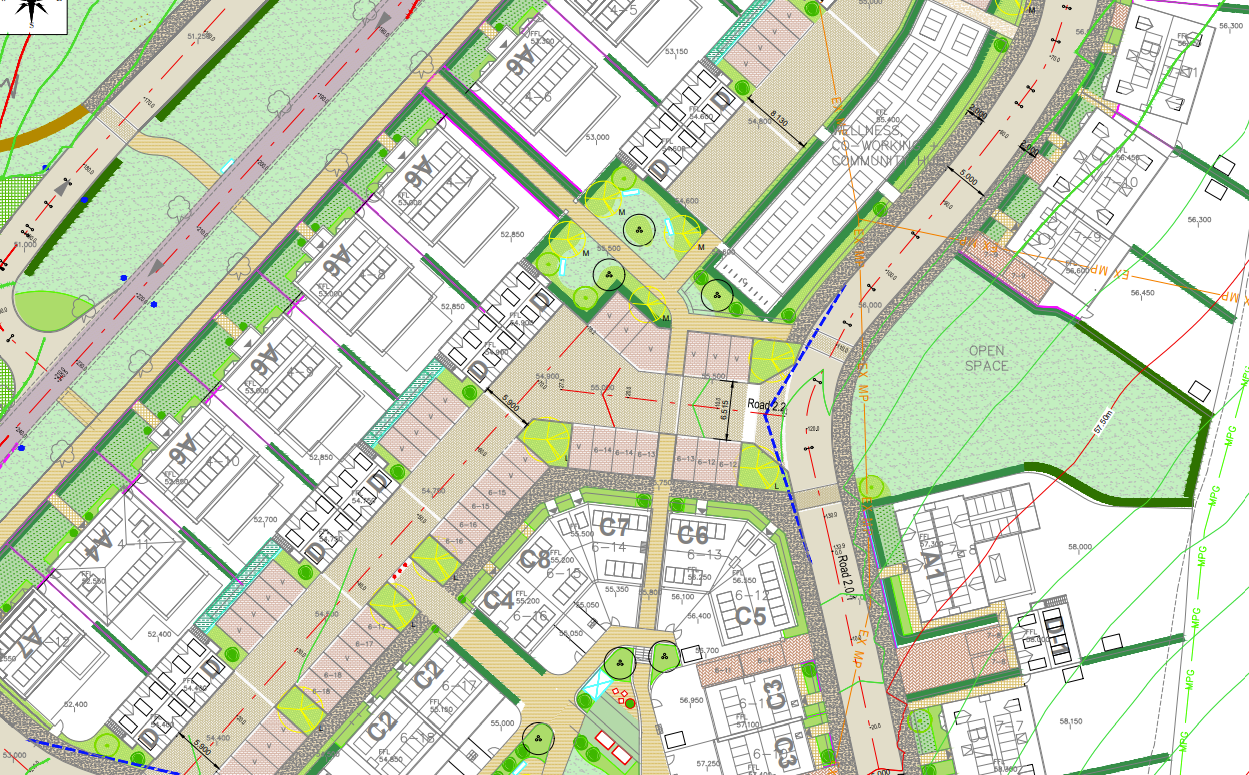
8. The design of the houses does not reflect Beaminster. It is an urbanisation of a very small town which, in reality, has the feel of a big village. It does not take into account the landscape and in the words of Dorset Council Urban design Officer “ The ED does not adequately consider landscape character. The form, scale, layout and quantum of development appears commercially driven rather than context led.” Even with the few modifications that have been done on the application it remains very much the same design, a carbon copy of Poundbury.
9. Full transparency regarding the conservation deficit calculation and viability evidence, independently reviewing all financial and viability assumptions, demonstration of minimum necessary, detailed assessment of impacts on Heritage asset, its landscape and historic setting, consideration of less harmful alternatives are all statements that Dorset Council must be prepared to scrutinise and obtain accurate answers from the applicant.
Despite, yet more documents posted on the portal, a few changes and a few houses removed, the vast majority of the application has remained the same, still without answers to the different points made by Aspinall Verdi amongst others.
Unless these matters can be clearly demonstrated, I feel the proposal is contrary to the statutory duty to give considerable importance and weight to the preservation of heritage assets and their settings and contrary to the principles governing enabling development.
I, therefore, request that planning permission be refused.
A Resident’s Objection
Want to help?
Read how to object to the Parnham planning application, or sign up for updates.